Quick answer
A video doorbell has "no monthly fee" only when it stores video somewhere you already own — a local SD card, or a self-contained indoor monitor — instead of a paid cloud account. Subscription doorbells (Ring, Nest, Arlo) still give you live view, motion alerts and two-way talk for free, but they hold your saved recordings behind a plan that typically costs US$4–US$10 a month. Over three years that's often US$120–US$300, frequently more than the device itself. If you want zero recurring cost, buy a doorbell that records locally or one that skips WiFi and the cloud entirely.
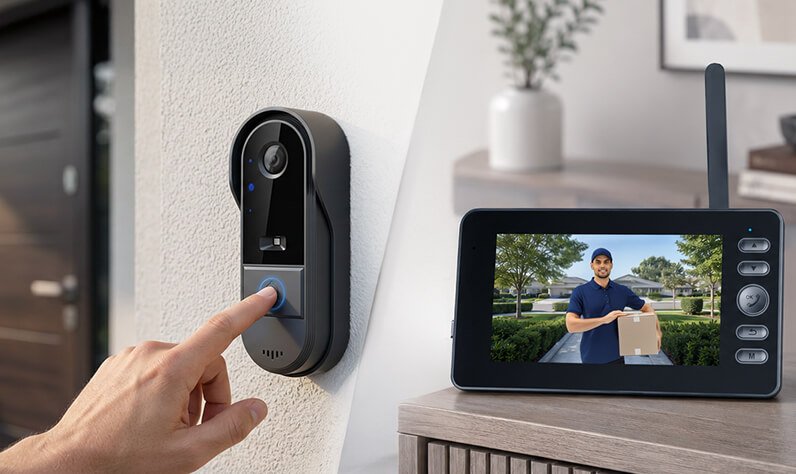
The hidden cost: what "free" doorbells actually charge for
The doorbell price on the box is only half the story. With most popular WiFi models, the fee you can't see at checkout is the one that pays for cloud video storage — the recordings you review later when you weren't watching live. Skip the plan and, on many brands, a motion event simply isn't saved: you get the ping on your phone, but no clip to show anyone afterward.
That's the honest dividing line. "No monthly fee" almost always means one of two things: the doorbell records to a memory card you own, or it sends video to an indoor monitor that keeps everything in the home. No cloud, no bill.
Subscription vs. no-fee doorbells, side by side
Approximate single-camera plan pricing as of 2026 — always confirm current rates, because these change often. The point isn't the exact number; it's which category charges a recurring fee at all.
| Doorbell type | Monthly fee for recordings? | Rough plan cost | Where video is stored |
|---|---|---|---|
| Ring-style (cloud) | Yes, for saved clips | ~US$4–5 / mo | Cloud account |
| Nest-style (cloud) | Yes, for event history | ~US$8–10 / mo | Cloud account |
| Arlo-style (cloud) | Yes, for recordings | ~US$8 / mo | Cloud account |
| Local-storage doorbell | No | US$0 | SD card you own |
| No-WiFi doorbell + monitor | No | US$0 | Indoor monitor / SD card |
How much a subscription really costs over three years
Run the math on the plan, not the sticker. Even at the cheap end:
- US$4/month → US$48 a year → US$144 over three years.
- US$8/month → US$96 a year → US$288 over three years.
- Add a second camera later and many plans step up again.
In other words, the "cheap" US$60 doorbell with a US$8 plan can quietly become a US$300+ purchase before it's three years old — while a no-fee model's cost stops the day you buy it. For a device most people keep for years, the subscription is usually the biggest number in the whole decision.
The two honest ways to pay no monthly fee
1. A doorbell that records to a local SD card. Some WiFi doorbells let you store clips on a card in the device instead of the cloud, dodging the fee. The catch: you still rely on WiFi, an app and an account, and if the unit is stolen the footage on the card goes with it.
2. A no-WiFi doorbell paired with an indoor monitor. Here the camera talks directly to a screen inside your home over a private radio link — nothing touches the internet, so there's no cloud to charge you and nothing online to hack. We explain exactly how that works in our guide to no-WiFi video doorbells. The trade-off is that you view the door from home, not from your phone across town.
What you give up going fee-free (the honest part)
- Remote viewing. No-WiFi and monitor-based models are for answering the door when you're home, not for checking it from the office. If away-from-home alerts are the whole point for you, a subscription model may genuinely be worth it.
- Effortless cloud backup. Local storage means you manage the SD card; cloud plans handle history automatically and keep it offsite.
- Searchable event timelines. Paid apps often organize clips by person, package or time — convenient if you review footage a lot.
None of that changes the core deterrence value at the door, though. As we covered in do video doorbells deter burglars, most doorstep crime is opportunistic — and a visible, always-on camera does that job whether or not you're paying for cloud storage.
A quick buyer's checklist for zero fees
- Does it record to a local SD card or an indoor monitor? (If neither, expect a plan.)
- Is live view, motion alert and two-way talk included without a plan?
- Is the "no subscription" claim about the whole device, or just a limited free tier?
- If it's WiFi-based, is your front-door signal actually strong enough?
- Do you truly need to see the door while away — or mostly while home?
Answer those five honestly and the right category picks itself. If your real need is "see and speak to whoever's at my door, with no bill ever," a no-WiFi doorbell with a monitor is usually the simplest match.