Quick answer
The online-shopping boom put a steady stream of strangers on American porches every single day — and it also left a visible trail that tells anyone watching which homes are empty and which packages are sitting unclaimed. Most couriers are honest and just doing a hard job, but doorbell cameras have repeatedly caught the small minority who steal the very parcels they were supposed to deliver, and opportunistic thieves have learned to read the same signals: piled-up boxes, predictable delivery windows, nobody answering the door. In a tight economy, low-risk, low-effort theft tends to rise. The simplest fix is an always-on camera at the door that records everyone who approaches and makes the house "answer" even when you're not home — ideally one that costs nothing to run after you buy it.
Why the front door became the softest spot in the house
A decade ago, a stranger walking up to your door was a rare event. Today it's routine: groceries, meal kits, pharmacy orders, and a river of e-commerce parcels mean many households see multiple deliveries a week — sometimes a day. That convenience quietly rewired the risk at the one entrance thieves care about most.
Every delivery leaves evidence in plain sight. A box on the step says a package just arrived and no one has come out to grab it. Two or three boxes stacked up say something louder: nobody has been home for a while. You don't need to be a professional to read that — you just need to walk down the street.
The delivery driver problem nobody likes to say out loud
Let's be fair first: the overwhelming majority of delivery drivers are honest people under real pressure, racing an app-driven clock to hit route quotas. But the sheer scale of the delivery economy means even a tiny bad-actor rate turns into a lot of incidents — and homeowners' own doorbell cameras have documented plenty of them. Local news across the U.S. regularly features footage of a driver scanning a package as "delivered," then walking off with it, or lingering to look through windows and side gates.
There's a second, subtler issue. A delivery role is the perfect reason to be on any porch, at any address, at any hour — no cover story needed. That same legitimacy that makes deliveries convenient also makes an empty-looking home easy to size up: a knock, a pause, a glance at the mail pile, and a read on whether anyone's around.
The "knock test" — now disguised as a delivery
As we covered in our look at what actually deters burglars, a large share of break-ins start with a simple knock. The intruder rings the bell with a ready excuse — "wrong address," "left a package next door" — and if nobody answers, the house has just failed the occupancy test. In the delivery era, that knock no longer looks suspicious at all. It looks like Tuesday.
This is exactly where a doorbell camera with two-way audio changes the math. You can answer any knock from inside — or, with a portable monitor, from any room in the house — without opening the door and without revealing whether you're home alone. The house always responds, so it never advertises itself as empty, whether the person at the door is a courier, a "surveyor," or someone just testing the handle.
Package theft: the most common porch crime, and it's getting worse
Porch piracy is now one of the most frequent property crimes in America — surveys consistently find that tens of millions of U.S. households have had at least one package stolen, and the numbers climb every holiday season. Package thieves are the purest opportunists there are: they work in seconds, in daylight, and their entire plan depends on not being seen or recorded.
A camera aimed at the doorstep attacks precisely that plan. Motion alerts tell you the instant someone steps onto the porch — courier or not — so parcels spend less time sitting out, and anyone tempted to grab one has to gamble on being watched live and recorded for the police.
Why economic pressure makes this worse right now
When household budgets tighten, opportunistic property crime tends to tick up, and the targets that get hit first are always the easy ones: the unattended porch, the house that looks empty, the door with no camera on it. You can't control the economy or your neighborhood's crime rate. You can control one thing — whether your front door is a soft target or a hard one.
The good news is that hardening the door no longer requires an expensive, wired-in system with a monthly bill. And in a downturn, avoiding that recurring bill matters as much as the deterrent itself.
What honestly protects the door — and what it can't do
- A visible camera deters opportunists, who avoid recorded, monitored homes and pick an easier target instead.
- It documents everyone who approaches — the single most useful thing you can hand police after a theft.
- It lets the house answer every knock, so it never signals "nobody home."
- What it can't do: physically block a determined intruder, or watch the back gate and windows. A camera is the always-awake layer at the door, not the whole plan — decent locks and lighting still matter.
The cheapest way to cover the door in 2026
Most "smart" doorbells solve the deterrence problem but re-create the money problem: they lean on your WiFi and quietly bill you every month to keep your own recordings. In a tight year, that subscription is exactly the wrong direction.
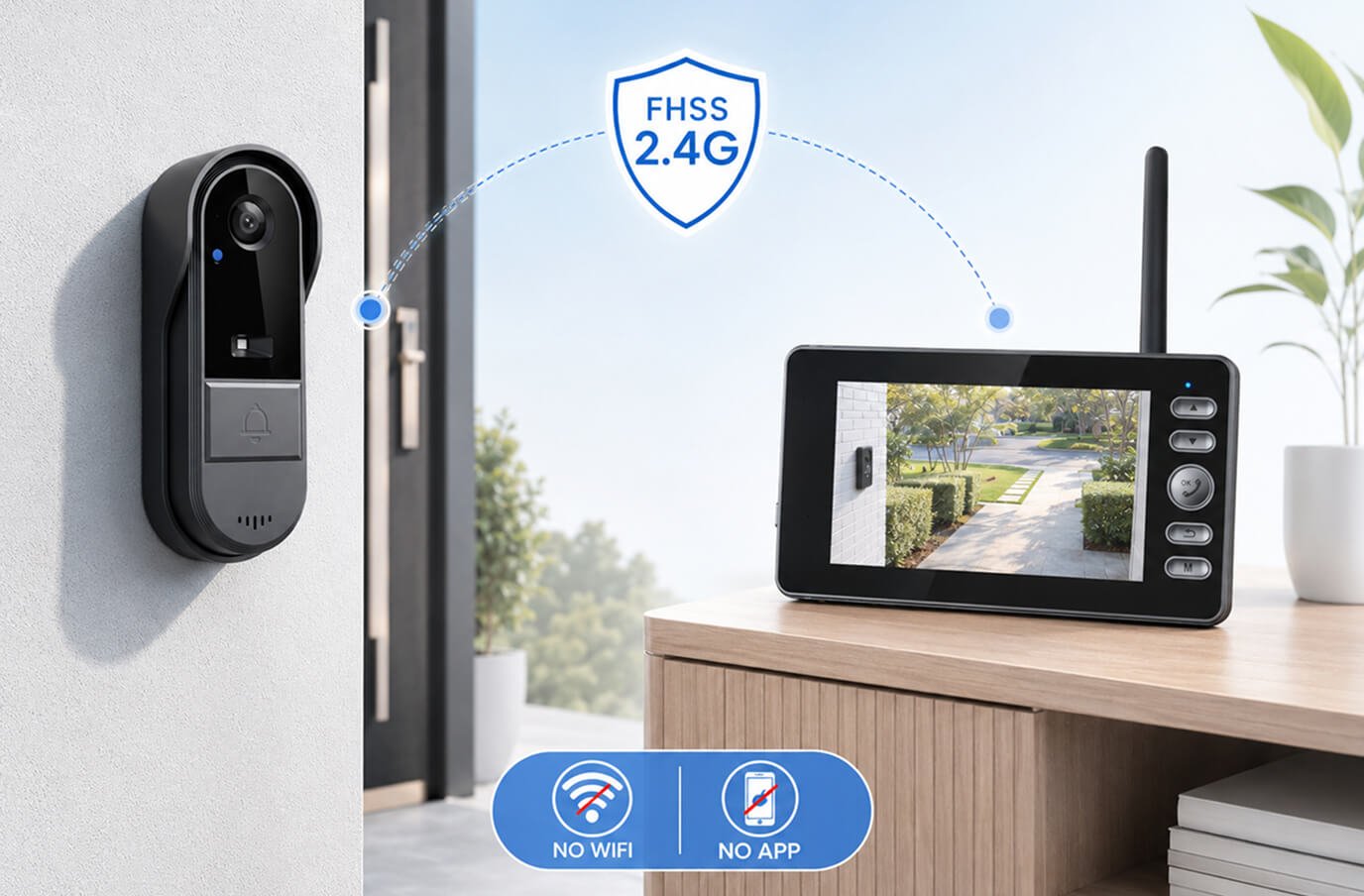
That's why we like the no-WiFi, no-subscription route for most households. A doorbell that links directly to its own indoor monitor over an FHSS 2.4G signal — explained in full here — gives you the deterrent, the recording, the motion alerts and the two-way "answer the door" ability, without a router dependency and without a bill that never stops. You buy it once. That's the whole cost.